A website built for a bidder who has never registered for a car auction before
A public auto auction website has to explain the process to someone who has only ever bought a car from a dealership lot, which means the registration steps, deposit terms and sale-day format need their own plain-language page, not a single paragraph on the homepage.
Built for public auto auction houses, not a generic auction template
If your house runs public auto auction houses, the site is built around the terms, timelines and registration rules specific to that format, rather than a listing template built for a different sale type entirely.
Public auto auctions draw first-time bidders everywhere, and we build for them across the United States, including busy retail markets in Texas, Florida, California and Arizona.
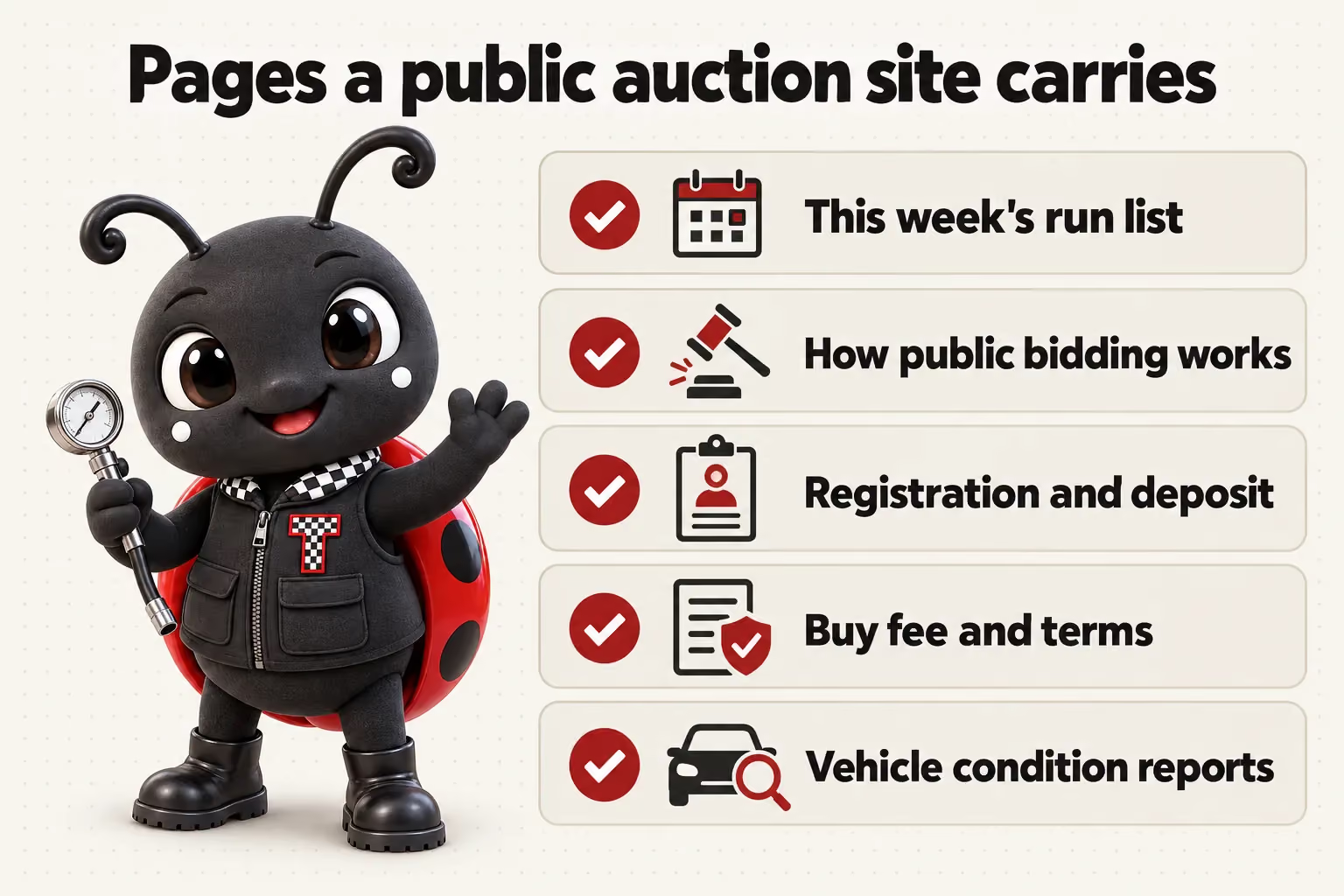
Four problems specific to public auto auction houses
First-time bidders arrive with no idea what a buy fee, floor price or arbitration window means, and leave rather than call to ask.
The registration form asks for a deposit without explaining what happens to it if the bidder does not win a vehicle.
There is no page distinguishing an as-is public sale from a dealer-only wholesale lane, so bidders show up expecting the wrong thing.
Vehicle photos and condition notes are inconsistent from listing to listing, making it hard to compare two cars in the same sale.
The pages built for public auto auction houses
- 1Home
- 2This week's run list
- 3How public bidding works
- 4Registration and deposit
- 5Buy fee and terms
- 6Sale-day schedule and location
- 7Vehicle condition reports
- 8Contact
Bidder registration and deposit form
Walks a first-time bidder through the deposit amount, refund terms and ID requirements before they show up, routed into your CRM.
How does the AI Engine help public auctions sales?
Handles the questions first-time bidders ask over and over: how registration works, what the deposit covers, what a buy fee is, when preview opens.
- AI receptionist for calls your team cannot take. Answers routine calls about sale times, registration requirements and lane information at any hour, and hands anything vehicle-specific to a person. Every conversation is available in a call-analysis PDF.
- AI chat widget on the site. A chat on every page that answers the same routine questions in writing and takes enquiry details for your team.
- AI answers on SMS, Messenger and Instagram. The same assistant replies to text messages, Facebook Messenger and Instagram DMs, and routes buyer registrations to your team.
- A2P 10DLC SMS registration handled. We file the carrier registration business text messaging needs in the US. Carrier fees are passed through at cost.
On Condition Report and Full Consignment.
What content gets published for you?
Plain-language guides for first-time bidders: buy fees, deposits, as-is sales, preview days and how to read a condition report.
Run List: 2 articles a week. Condition Report: 2 articles a week. Full Consignment: 3 articles a week.
What public auctions houses report
They asked to see the questions customers genuinely ask us about vehicle auction registration, which I respected. They identified which questions belonged on the site and we checked every answer before launch. The phone calls about basic vehicle auction registration details have noticeably thinned out.
The 'did you receive it?' calls about vehicle auction registration were a daily occurrence here. Now the sender gets a summary, the next step in plain language, and a way to correct mistakes. Duplicate submissions have dropped away almost completely.
My worry was the vehicle auction registration page we had linked from years of emails. The redirect plan was presented for our approval like any other deliverable. The relaunch felt safe rather than hopeful.
What happens after you order?
- Order
You pay the first month
That starts the plan and books your build. No build fee is charged at this point.
- Call
One onboarding call
About 30 minutes on your lanes, sale formats, run list, domain and CRM. You leave with a launch date.
- Supply
You send what you already have
A recent run list, one condition report, lot photos, sale terms and fees. One person on your side approves pages.
- Build
We build and you review
Every page, registration, hosting, redirects and the compliance pages, with your notes gathered in the client portal.
- Launch
You approve, it goes live
Live in 7 to 15 days depending on plan. The build fee is invoiced only after you approve.
- Run
Weekly updates from then on
Run list changes, 5 revisions a month, articles every week, and on higher plans the AI Engine and Content Engine.
Every tier fits public auto auction houses
- Run ListThe website, fully managed, live in 7 days
- Condition ReportEverything, plus the AI Engine, live in 10 days
- Full ConsignmentEverything, plus the Content Engine, live in 15 days
Questions from public auto auction houses
Can the site explain what happens to a deposit if a bidder does not win a vehicle?
Yes, the registration page states your deposit and refund terms in plain language, and we build that language from the policy you provide rather than a generic template.
Can we run both public and dealer-only lanes from one site?
Yes, lane pages can be tagged by access type so a public sale and a wholesale lane sit on the same site without reading as the same offer.
Do you write the condition notes for each vehicle?
No, we build the condition report layout; your team or inspector supplies the actual notes, since that judgment has to come from someone who has looked at the vehicle.
Can bidders see photos before sale day?
Yes, vehicle photos publish with the run list as soon as your team uploads them, typically ahead of preview hours.
Can the site explain buy fees before someone registers?
Yes. A buyer fee page states your fees in plain language from your own policy, linked from registration and every listing.
Can bidders register for a specific sale date?
Yes. The registration form can ask which sale a bidder is registering for and route that to your CRM.
Do you support bilingual pages?
The site launches in US English. Additional languages are a content project we can scope with you.
Which plan do public auctions usually choose?
Condition Report, because first-time bidders ask the most after-hours questions, which the AI Engine answers.
See it built for public auctions
A live walk-through, on your screen, of the site you would get.
Book a demoAlso built for: Dealer-only, Salvage, Classic & collector