A website that states title status and damage plainly before anyone bids
A salvage auction website has to lead with title status and damage disclosure, because a buyer bidding on a total-loss vehicle is making a very different decision than a buyer at a retail sale, and burying that information erodes trust immediately.
Built for salvage and total-loss auction houses, not a generic auction template
If your house runs salvage and total-loss auction houses, the site is built around the terms, timelines and registration rules specific to that format, rather than a listing template built for a different sale type entirely.
Salvage and total-loss sales run in every state; we build for yards and auctions across the United States, from Georgia and North Carolina to Texas, Illinois and Pennsylvania.
Four problems specific to salvage and total-loss auction houses
Title status (salvage, rebuilt, flood, parts-only) is not visible until a buyer opens a separate document, if it appears at all.
Damage photos are inconsistent, some lots have none, making it hard for a remote bidder to assess a vehicle honestly.
There is no page explaining how online or absentee bidding works for buyers who cannot attend a physical lane.
Licensed rebuilder and exporter buyers have no dedicated registration path separate from general public bidders.
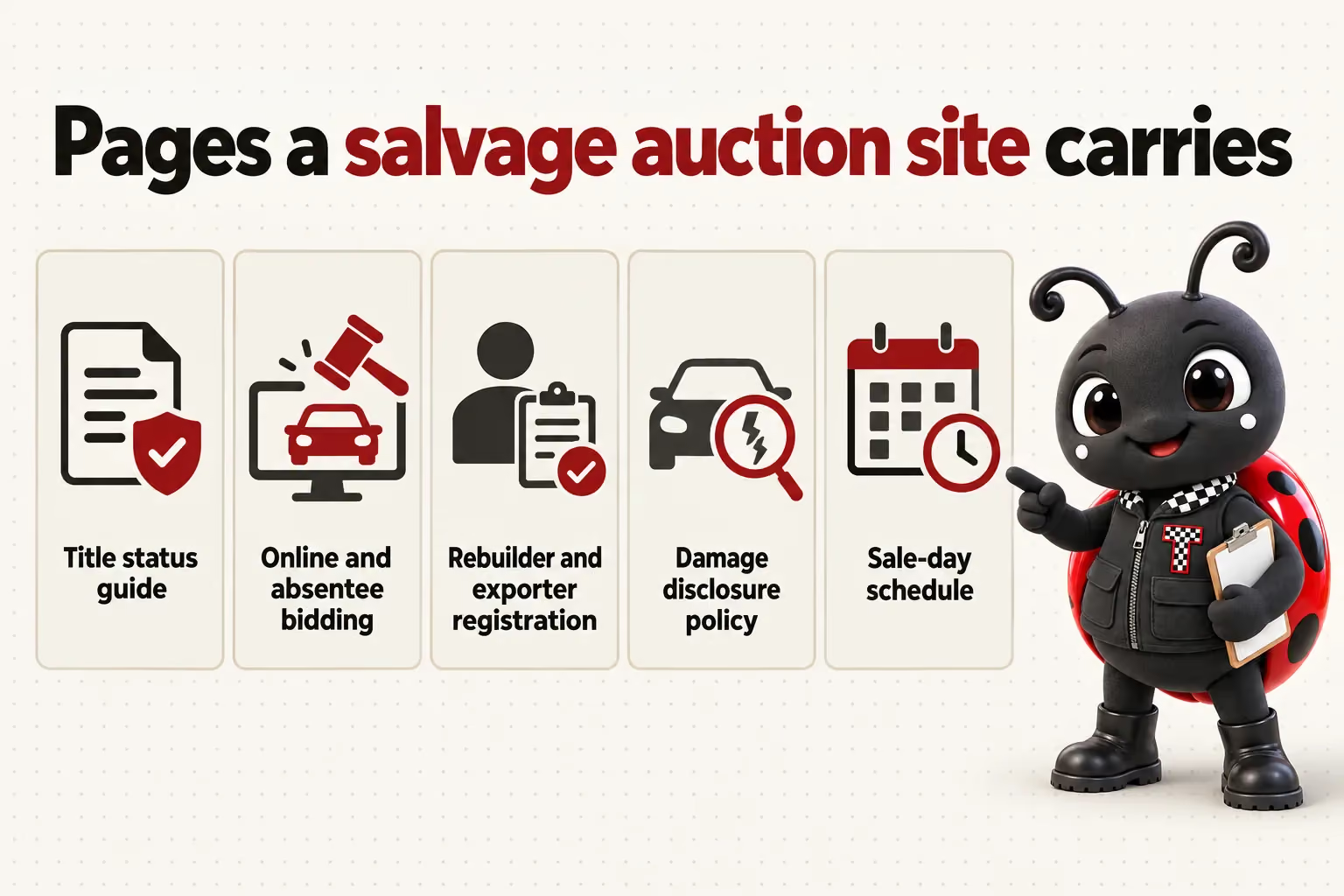
The pages built for salvage and total-loss auction houses
- 1Home
- 2This week's run list
- 3Title status guide
- 4Online and absentee bidding
- 5Rebuilder and exporter registration
- 6Damage disclosure policy
- 7Sale-day schedule
- 8Contact
Title-status flagged listing form
Structures every listing so title status and damage category are required fields, not optional notes, before a lot can publish.
How does the AI Engine help salvage sales?
Answers routine questions about registration, rebuilder and exporter paperwork and pickup times. It never comments on a vehicle's damage, title or value.
- AI receptionist for calls your team cannot take. Answers routine calls about sale times, registration requirements and lane information at any hour, and hands anything vehicle-specific to a person. Every conversation is available in a call-analysis PDF.
- AI chat widget on the site. A chat on every page that answers the same routine questions in writing and takes enquiry details for your team.
- AI answers on SMS, Messenger and Instagram. The same assistant replies to text messages, Facebook Messenger and Instagram DMs, and routes buyer registrations to your team.
- A2P 10DLC SMS registration handled. We file the carrier registration business text messaging needs in the US. Carrier fees are passed through at cost.
On Condition Report and Full Consignment.
What content gets published for you?
Articles explaining title brands, damage categories, remote bidding and pickup logistics in general terms, with sources cited.
Run List: 2 articles a week. Condition Report: 2 articles a week. Full Consignment: 3 articles a week.
What salvage houses report
The part I rate most highly is the form, not the visuals. It collects bidder type, sale date and vehicle reference up front, so the back-and-forth we used to do by reply has largely gone. It has quietly removed the slowest step in our intake.
We reviewed the draft on handsets rather than a big screen, deliberately. The important details sit near the top and the inquiry button is impossible to miss. The days of talking customers through the menu are over.
They asked to see the questions customers genuinely ask us about vehicle auction registration, which I respected. They identified which questions belonged on the site and we checked every answer before launch. The phone calls about basic vehicle auction registration details have noticeably thinned out.
What happens after you order?
- Order
You pay the first month
That starts the plan and books your build. No build fee is charged at this point.
- Call
One onboarding call
About 30 minutes on your lanes, sale formats, run list, domain and CRM. You leave with a launch date.
- Supply
You send what you already have
A recent run list, one condition report, lot photos, sale terms and fees. One person on your side approves pages.
- Build
We build and you review
Every page, registration, hosting, redirects and the compliance pages, with your notes gathered in the client portal.
- Launch
You approve, it goes live
Live in 7 to 15 days depending on plan. The build fee is invoiced only after you approve.
- Run
Weekly updates from then on
Run list changes, 5 revisions a month, articles every week, and on higher plans the AI Engine and Content Engine.
Every tier fits salvage and total-loss auction houses
- Run ListThe website, fully managed, live in 7 days
- Condition ReportEverything, plus the AI Engine, live in 10 days
- Full ConsignmentEverything, plus the Content Engine, live in 15 days
Questions from salvage and total-loss auction houses
Can title status show as a flag on every listing automatically?
Yes, the run list template requires a title-status field before a listing can publish, so it is never left off a page by omission.
Do you determine or verify title status?
No, title status comes from your records or the insurer providing the vehicle; we build the field and the page it displays on, not the determination itself.
Can out-of-state or export buyers register remotely?
Yes, an online and absentee bidding page can walk a remote buyer through registration and proxy bidding without requiring a lane visit.
Can rebuilder and exporter buyers get a separate registration path?
Yes, a dedicated registration form can route these buyers differently from general public bidders, useful if their licensing requirements differ.
Can we publish pickup deadlines and storage fees?
Yes. Pickup and storage terms can sit on their own page and on every listing, written from your policy.
Can remote buyers see enough to bid without visiting?
Listings carry consistent damage photos, title status and odometer status, with a clear link to your online bidding platform.
Do you handle export paperwork?
No. We explain your process on the site; the paperwork and determinations stay with your team.
Can title brands differ by state on one listing?
The title field shows exactly what your paperwork says, including the issuing state if you choose to show it.
See it built for salvage
A live walk-through, on your screen, of the site you would get.
Book a demoAlso built for: Dealer-only, Public auctions, Classic & collector