A documentation-rich lot template
Room for build sheets, ownership history and service records alongside photos.
Not sure where you fit?
Tell us what lanes you run and we will show you the closest build.
Book a demoSee every feature
Speed, run list pages, articles, hosting and the AI Engine, in one place.
View featuresBlack Friday, one week only
Once a year the monthly fee comes down and the build fee stays off the ticket.
See the saleClassic car auction website design slows down where a wholesale auction site speeds up, because a collector researching a matching-numbers engine or an original paint car reads provenance and documentation before they check the estimate.
What it costs
Classic, collector and specialty sale houses where every lot carries a story, a provenance and a consignor who is watching how it is presented.
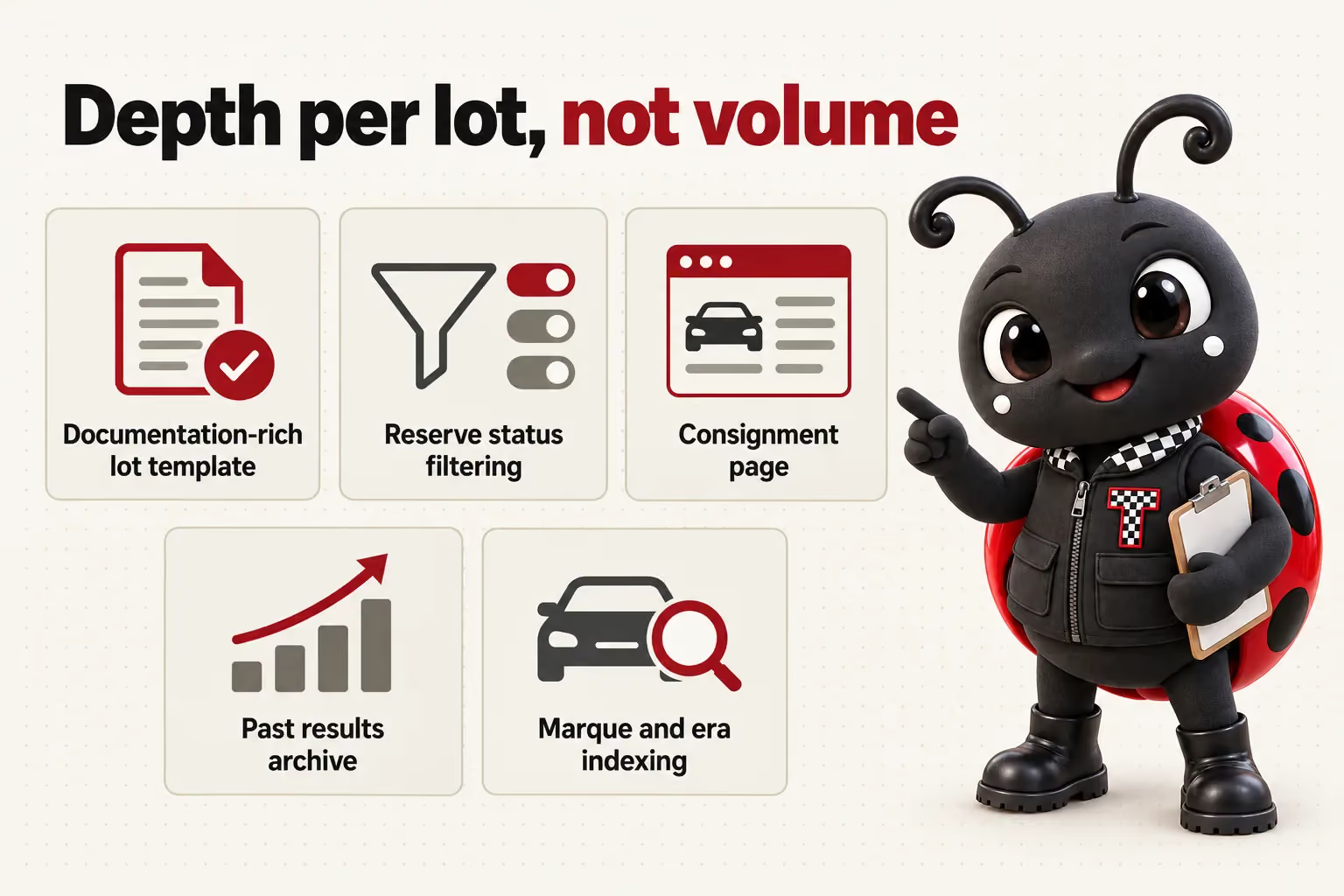
A classic car catalog is typically a dozen to a few dozen lots, not hundreds, so the page template is built for depth: a documentation section for build sheets and ownership history, a larger photo set, and room for a real description, rather than a compact card built to summarize a hundred-vehicle wholesale run list.
Whether a lot is reserve or no-reserve matters more to a collector than to a wholesale buyer, so the design surfaces it clearly on every lot and allows catalog filtering by reserve status, letting a buyer who specifically searches for no-reserve sales find them directly.
An owner deciding where to consign a car reads a different page than a buyer does: provenance handling, marketing reach, and a past sale results archive showing what similar cars have brought at your sales. We build that consignor path as its own section rather than folding it into general contact information.
Room for build sheets, ownership history and service records alongside photos.
Catalog filtering that separates reserve and no-reserve lots for collector buyers.
A dedicated path for owners considering where to consign a vehicle.
A public record of what has crossed your block, organized by marque and era.
Browse structure built around how collectors actually search, not a flat list.
Everything on this page is built on every plan. Higher plans add the AI Engine and the Content Engine.
| Included | Run List | Condition Report | Full Consignment |
|---|---|---|---|
| A page for every vehicle on the run list | |||
| Lane, sale-day and sale-format pages | |||
| A buyer-facing condition report layout | |||
| Buyer registration and dealer credential form, into your CRM | |||
| Weekly run list and detail updates | |||
| SEO, AEO, GEO and structured data | |||
| Managed hosting, SSL and security | |||
| Compliance pages and consent | |||
| AI receptionist for calls your team cannot take | |||
| AI chat widget on the site | |||
| AI answers on SMS, Messenger and Instagram | |||
| 3 social image posts and 2 reels a week | |||
| Managed Google Business Profile |
Live in 7, 10 or 15 days depending on plan, counted from the onboarding call.
That starts the plan and books your build. No build fee is charged at this point.
About 30 minutes on your lanes, sale formats, run list, domain and CRM. You leave with a launch date.
A recent run list, one condition report, lot photos, sale terms and fees. One person on your side approves pages.
Every page, registration, hosting, redirects and the compliance pages, with your notes gathered in the client portal.
Live in 7 to 15 days depending on plan. The build fee is invoiced only after you approve.
Run list changes, 5 revisions a month, articles every week, and on higher plans the AI Engine and Content Engine.
We reviewed the draft on handsets rather than a big screen, deliberately. The important details sit near the top and the inquiry button is impossible to miss. The days of talking customers through the menu are over.
What I value about the vehicle auction registration guide is its restraint. It explains what the first conversation needs, and deliberately asks for nothing sensitive online. We include it in our first response as standard.
We knew the vehicle auction registration document was a problem; we had just never prioritized fixing it. Staff now link to the precise section instead of wishing callers luck with a long document. Callers have stopped apologizing for not being able to read it.
Yes, the layout is built for depth per lot rather than volume, so a catalog of a dozen cars reads as curated rather than sparse.
No, we build the page and its fields; provenance and history details come from your specialists, since that expertise has to come from someone who has researched the vehicle.
Yes, catalog filtering can separate reserve and no-reserve lots, a distinction collector buyers search for specifically.
Yes, past results can archive with whatever detail you choose to publish, building a public record of your sale history over time.
Yes. Lot pages hold a structured summary up top and long-form history, documents and photo sets below, without slowing the page.
Yes. Closed lots move into a results archive, which is often the most persuasive page for a new consignor.
You or your specialists supply the facts about each car. We lay them out and can polish the wording, but we never state condition or value ourselves.
Full Consignment adds social posts, reels and a managed Google Business Profile, which suits houses promoting a small number of standout lots.
One call to walk through your lanes, sale formats, current run list and any existing branding, so we can plan the site structure before building starts. It typically runs under an hour.
5 revisions are included every month with no size limit per revision, from a single status change to a full run list refresh. Additional revisions are a flat $20 each, with no hourly billing, completed within 2 to 5 working days.
A live walk-through of the site you would get, in about 30 minutes. Plans from $127 a month, the $697 build fee invoiced only after launch, domain and hosting included.
Book a demoOr email and a person replies within one working day.
GetCarAuctionSites uses the cookies below. Necessary cookies keep the site working and cannot be turned off.
Saved on this device only. Press Esc to close.